
Choosing the right Circuit Board Material can determine a product’s reliability, thermal performance, and total manufacturing cost. In 2026, global buyers face more options than standard FR-4. High-Tg laminates, halogen-free materials, polyimide, PTFE, and metal-core boards serve different engineering demands. No material wins every design.
A practical selection process starts with operating conditions. A control board inside a factory may need heat resistance, stable dimensions, and long-term mechanical strength. A high-frequency communication module may require low dielectric loss and controlled signal behavior. Automotive and power applications often demand stronger thermal management. Materials must also match fabrication limits, including layer count, copper weight, drilling, and surface finish.
Cost still matters. It should not lead the decision. A lower-priced laminate may create higher failure risks during assembly or field use. Buyers should compare supplier datasheets, IPC compliance, test reports, traceability, and production experience. Regional availability can influence lead times and consistency. However, certifications alone do not guarantee suitable performance. That assumption can fail.
This guide examines the leading circuit board material types for global buyers in 2026. It connects material properties with real purchasing decisions, from prototype builds to volume production. The discussion also considers moisture absorption, thermal expansion, signal integrity, sustainability goals, and supply reliability. Some comparisons remain imperfect because suppliers use different test methods. Careful verification is still necessary. A strong specification protects both engineering performance and procurement confidence.
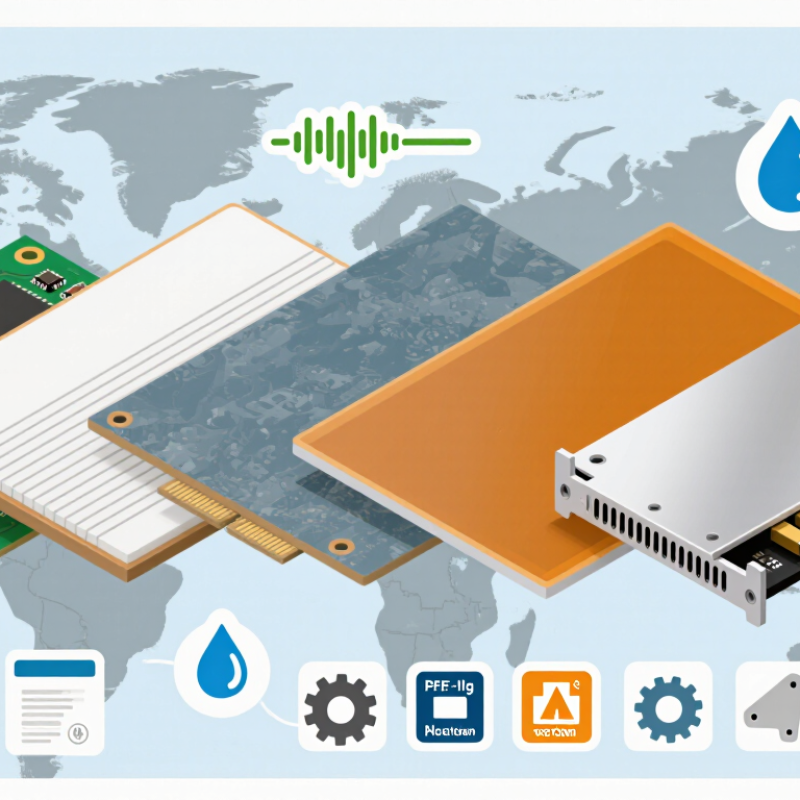
Circuit board materials form the physical foundation of every printed circuit board. They include the base laminate, copper foil, solder mask, and protective surface finish. The laminate supports electrical paths and mechanical stress. Copper carries current through traces and layers. Small detail. Material selection affects heat, signal quality, reliability, and cost.
FR-4, made from glass fiber and epoxy resin, remains a practical choice for many control and consumer products. Aluminum-backed boards can move heat away from high-power components, especially when mounted against a metal surface. Polyimide supports flexible circuits that bend inside compact devices. PTFE and ceramic materials can serve high-frequency or high-temperature designs, but they usually demand tighter process control and higher budgets. These options are not interchangeable.
Global buyers should compare dielectric thickness, thermal conductivity, copper weight, moisture resistance, and operating temperature. A datasheet may look complete, yet it cannot replace production evidence. Request material certifications, test reports, traceability records, and samples from the intended manufacturing lot. IPC material specifications can provide a useful reference, while regional safety requirements may differ.
A recurring mistake is choosing the cheapest laminate before checking drilling, assembly, and shipping conditions. I have seen a lower material price become a higher total cost after warping or rework appeared. The better decision is not always the most advanced material; it is the one matched carefully to voltage, heat, flexibility, frequency, and expected service life.
In 2026, circuit board materials are classified by structure, electrical behavior, heat resistance, and manufacturing needs. The clearest starting point is board construction. Rigid boards use solid laminates, while flexible boards use bendable polymer films. Rigid-flex boards combine both forms in one circuit. This classification affects assembly space, bending radius, repair access, and expected service life.
Material families create another useful layer. Standard epoxy-glass laminates suit many general electronics and moderate-temperature applications. High-temperature laminates support repeated thermal cycling and lead-free assembly more reliably. Halogen-free options address specific environmental and compliance requirements. Polyimide materials serve flexible circuits, especially where repeated bending matters. High-frequency materials use carefully controlled dielectric properties for signal-sensitive designs. Metal-core and ceramic substrates help move heat away from power components. They are not interchangeable.
In buyer evaluations, I compare datasheet values with the actual stack-up and process conditions. Key figures include glass-transition temperature, thermal conductivity, dielectric constant, dissipation factor, copper adhesion, and moisture resistance. A material with excellent heat transfer may be difficult to drill or laminate. A low-loss material may increase cost or require tighter processing control. That trade-off is easy to overlook. Classification also depends on thickness, copper weight, surface finish, and operating environment. In practice, material labels overlap, and supplier descriptions can sound more precise than they are. Sample testing, cross-section inspection, and production feedback remain necessary before global volume purchasing.
Circuit board materials must match the technology, operating environment, and production method. Standard FR-4 remains common for digital control boards, industrial sensors, and consumer electronics. Its woven glass structure provides practical stiffness and cost control. Higher-Tg grades suit equipment exposed to repeated heating, such as power supplies and engine monitoring units.
High-speed boards need materials with stable dielectric properties and low signal loss. Low-loss laminates support 5G modules, radar units, and high-frequency communication equipment. PTFE-based materials can perform well at microwave frequencies, but they often require tighter drilling and special processing. Ceramic-filled options improve thermal performance and dimensional stability. Design reviews must check the full stack-up, not just the material datasheet.
Flexible circuits usually use polyimide because it tolerates bending and moderate heat. Rigid-flex boards combine this layer with rigid laminate sections, reducing connectors inside compact devices. Aluminum-backed boards help remove heat from LED lighting and motor controllers. Ceramic substrates can handle demanding thermal cycles, although their brittleness increases assembly risk. Material charts can mislead. A low-loss choice may fail under moisture, vibration, or poor plating control. Buyers should request test data, traceability records, and samples from the actual production process. Small mistakes matter. Temperature cycling, bend testing, and impedance checks reveal weaknesses before shipment.gbc
In 2026, global buyers should compare circuit board materials beyond the quoted sheet price. Standard FR-4 remains practical for controllers, sensors, and general industrial equipment. A six-layer FR-4 board can offer stable processing and predictable supply. High-Tg laminates handle heat better near power devices and dense connectors. They cost more. Polyimide supports flexible circuits in cameras, medical instruments, and compact wearables. PTFE-based materials deliver excellent high-frequency performance, but their processing requirements can raise production costs.
Material price is only one part of the purchasing decision. A low-cost laminate may need thicker copper, extra thermal management, or tighter process controls. Those additions can erase the original saving. Aluminum-backed boards work well for LED lighting and other heat-producing assemblies. They are less suitable where electrical insulation and complex routing dominate. Performance depends on the whole stack-up, not the resin name alone. Datasheets help, but factory trials reveal more.
Sustainability is harder to measure. Longer board life can reduce replacement waste and service visits. Halogen-free construction may support environmental goals, yet it does not automatically mean lower impact. Buyers should request recycled-content data, energy information, and end-of-life guidance. Recycling remains difficult for mixed-material boards. That reality deserves more attention. Supplier claims also need independent review, especially when testing methods differ. A sensible choice balances thermal needs, signal speed, cost, repairability, and verified environmental data. No material wins every test.
| Material Type | Typical Construction | Typical Tg or Service Temperature | Typical Dielectric Constant (Dk) | Typical Thermal Conductivity | Dimensional Stability | Relative Material Cost* | Key Advantages | Main Limitations | Sustainability Considerations | Common Buyer Applications |
|---|---|---|---|---|---|---|---|---|---|---|
| Standard FR-4 Epoxy Glass | Woven glass reinforcement with flame-retardant epoxy resin | Tg typically 130–150°C; continuous use commonly below approximately 130°C | Approximately 4.0–4.5 at 1 GHz | Approximately 0.25–0.40 W/m·K | Good in-plane stability; higher Z-axis expansion than advanced high-temperature laminates | 1.0× baseline | Broad availability, mature processing, good electrical insulation, strong cost-to-performance balance | Limited high-temperature endurance; moisture and frequency effects must be considered in demanding designs | Long service life and established recycling routes for copper recovery; thermoset glass-epoxy separation remains difficult | Consumer electronics, industrial controls, general computing, appliances, automotive low-to-medium thermal loads |
| High-Tg FR-4 | Enhanced epoxy-glass laminate with higher glass-transition temperature | Tg typically Tg 170–200°C; practical continuous-use limits depend on the resin system and design | Approximately 3.8–4.5 at 1 GHz | Approximately 0.30–0.45 W/m·K | Better Z-axis dimensional stability and lower thermal expansion than standard FR-4 | 1.2–1.6× baseline | Improved thermal reliability, lead-free assembly compatibility, and better resistance to repeated thermal cycling | Higher price and processing requirements; still less heat-conductive than metal-core or ceramic solutions | Longer product life can reduce replacement waste; thermoset composite recycling remains challenging | Automotive electronics, telecom equipment, power-management boards, industrial and aerospace control systems |
| Polyimide | Polyimide resin reinforced with glass or flexible-film structures | Tg often above 250°C for rigid systems; flexible grades may be specified by continuous-use temperature instead | Approximately 3.5–4.5 at 1 GHz | Approximately 0.20–0.40 W/m·K | Excellent flexibility and strong thermal-cycling performance; dimensional control depends on construction | 2.0–4.0× baseline | High-temperature capability, flex endurance, low outgassing options, and suitability for dynamic circuits | Higher material and fabrication cost; moisture absorption and handling requirements vary by formulation | Long operating life can offset higher embodied impact; material recovery is difficult because of multilayer polymer constructions | Flexible circuits, aerospace, medical devices, high-temperature sensors, dynamic interconnects |
| PTFE / High-Frequency Laminate | PTFE-based dielectric, often reinforced with glass, ceramic, or other fillers | Service temperature commonly about 200–260°C, depending on grade and mechanical design | Approximately 2.1–3.5 at 1 GHz | Approximately 0.20–0.60 W/m·K | Low moisture absorption and stable high-frequency electrical behavior; mechanical expansion requires careful design | 3.0–8.0× baseline | Low dielectric loss, low Dk options, excellent signal integrity, and strong performance at microwave frequencies | Expensive, more difficult to drill and plate, and mechanically softer than epoxy-glass materials | Low moisture uptake supports long life; fluoropolymer production and end-of-life recovery require controlled environmental practices | Radar, antennas, satellite communications, 5G/6G radio-frequency modules, microwave instrumentation |
| Metal-Core / Aluminum PCB | Metal baseplate, electrically insulating dielectric layer, and copper circuit layer | Design temperature commonly around 100–150°C at the dielectric; the metal baseplate may tolerate higher temperatures | Dielectric layer typically approximately 3.0–4.0 | Effective heat dissipation commonly about 1–8 W/m·K through the dielectric, with much higher conductivity through aluminum | Good thermal spreading; CTE mismatch between copper, dielectric, and metal base requires attention | 1.3–2.5× baseline | Efficient heat spreading, reduced thermal resistance, mechanical rigidity, and potential for simpler thermal assemblies | Usually one- or two-layer focused; limited routing density and possible insulation or grounding constraints | Aluminum and copper have established recycling value; improved thermal management may reduce cooling energy and component failure | LED lighting, power converters, motor drives, automotive lighting, battery and power electronics |
| Alumina Ceramic | Aluminum-oxide ceramic substrate with thick-film or thin-film metallization | Often supports operation above 500°C in suitable assemblies; actual limit depends on metallization and packaging | Approximately 9.0–10.0 at 1 GHz | Approximately 20–30 W/m·K for common alumina grades | Very good temperature stability and low moisture absorption; brittle and sensitive to mechanical shock | 4.0–10.0× baseline | High thermal conductivity, excellent electrical insulation, low outgassing, and strong high-temperature reliability | Brittleness, specialized processing, limited large-panel flexibility, and higher procurement cost | Long service life and chemically stable composition; energy-intensive firing and specialized recycling are important considerations | Power modules, high-temperature sensors, LED packages, aerospace electronics, hermetic and high-reliability systems |
| CEM-1 / Composite Paper-Epoxy | Paper-based core with epoxy resin and glass-fiber outer layers | Tg commonly around 110–130°C | Approximately 4.0–5.0 at 1 GHz | Approximately 0.20–0.35 W/m·K | Suitable for simpler, lower-stress designs; lower mechanical and thermal performance than FR-4 | 0.7–0.9× baseline | Low cost, easy punching or routing in selected designs, and adequate insulation for basic products | Not ideal for plated-through-hole complexity, high layer counts, high temperatures, or demanding mechanical loads | Lower material cost and relatively low mass; composite thermoset construction limits conventional paper recycling | Low-cost consumer products, simple control panels, chargers, toys, and single- or double-sided boards |
In 2026, material selection should begin with electrical and thermal loads, not the lowest quotation.
Grand View Research’s 2024 analysis valued the global PCB market at US$76.9 billion in 2023. It projects a 5.6% compound annual growth rate through 2030. That scale rewards disciplined specification.
For standard digital controls, woven-glass epoxy laminates remain practical. Choose high-Tg grades when lead-free assembly and repeated heating are expected. Polyimide suits flexible circuits and tight bending radii. PTFE-based or ceramic-filled laminates fit high-frequency paths, where dielectric loss matters. Metal-core boards can move heat quickly, but they offer less routing freedom.
Small detail, large consequence.
Global buyers should compare Tg, decomposition temperature, z-axis CTE, Dk, Df, moisture absorption, copper peel strength, and thickness tolerance.
IPC-4101E provides a useful qualification baseline, but it cannot replace application testing. The 2024 IPC World PCB Production Report estimated global PCB production at about US$89.7 billion in 2023. Its scope differs from market studies, so the figures should not be compared mechanically.
Cost pressure is real. Yet a cheaper laminate may increase drilling defects, warpage, or retesting. Request lot-level certificates, sample coupons, and thermal-cycle data before approval. Verify compliance documents for the destination market.
In sourcing reviews, I have seen teams overvalue Tg and overlook Df at operating frequency.
That is an uncomfortable gap.
Ask the fabricator to model stack-up, impedance, and heat paths together. Then challenge the assumptions.
WhatsApp us