China Top 10 UV Small Printers for Global Buyers
China has become a major source of compact UV printing equipment for international businesses. This guide examines China’s top 10 Uv Small Printers for global buyers seeking reliable production without excessive floor space. These machines can print on acrylic, wood, leather, metal, glass, and coated promotional materials. A small workshop can turn blank phone cases into colorful, finished products within minutes.
The selection focuses on practical buyer concerns, not attractive brochures alone. We compare print area, resolution, white-ink performance, varnish options, curing lamps, software compatibility, and maintenance access. We also consider ink costs, delivery support, spare parts, training, and warranty terms. Details matter. A clogged white-ink channel can stop production during a busy afternoon. A weak vacuum platform may affect small signs and uneven materials. Reliable suppliers should provide test samples, clear technical specifications, factory evidence, and responsive after-sales communication.
Global buyers must also check voltage, plug standards, packaging quality, customs documents, and local safety requirements. Supplier claims deserve verification through videos, sample testing, and written agreements. No ranking is perfect. Some models perform well on flat products but struggle with curved objects or thick media. Others offer attractive prices while requiring stronger technical support. That difference can change the real ownership cost. Our review aims to provide a balanced starting point for distributors, print shops, sign makers, and growing online businesses. Small equipment still needs serious evaluation. The best choice depends on material range, daily workload, operator skill, and service expectations.
What Are UV Small Printers and How Do They Work?
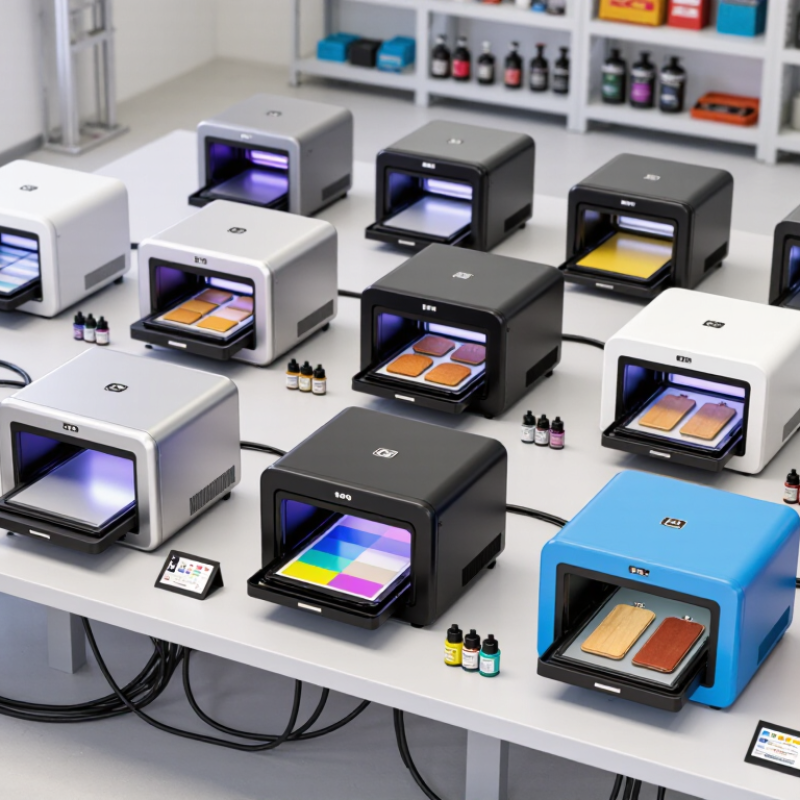
UV small printers are compact digital machines designed for direct printing on rigid or lightly flexible objects. They commonly handle phone cases, acrylic sheets, wood panels, coated metal, and promotional items. Unlike traditional printers, they do not require paper as the main printing surface. Their adjustable print beds support short production runs and personalized products.
The working principle is precise. A printhead deposits tiny drops of UV-curable ink onto the surface. UV LED lamps cure the ink almost immediately, turning it into a solid, durable layer. White ink can create a bright base on dark materials, while varnish can add gloss or texture. The printer may use a flatbed table or a rotary attachment for cylindrical objects. Surface cleaning still matters. Dust, oil, and unsuitable coatings can reduce adhesion.
The workflow usually includes artwork preparation, height measurement, surface testing, printing, and inspection. Operators must check ink compatibility before accepting large orders. A sample may look excellent, yet fail after rubbing or bending. This is where practical experience matters. Small does not mean effortless. Buyers should examine curing performance, nozzle maintenance, software support, electrical requirements, and safety documentation. I would also request test prints on the exact material, because online specifications rarely reveal every production problem.
Key Features to Compare in Compact UV Printing Equipment
China Top 10 UV Small Printers for Global Buyers
Key Features to Compare in Compact UV Printing Equipment
Compact UV printers are judged by more than cabinet size. Check the usable print area, substrate height, and table stability first. A 60 cm machine may struggle with uneven phone cases or thick promotional boards. During practical testing, inspect fine text, skin tones, and white-layer coverage at normal production speed. Slow samples can look impressive.
Ink and curing performance deserve close attention. Grand View Research estimates the global UV-curable ink market will expand strongly through 2030, driven by short-run and customized printing. That trend raises expectations for adhesion, color consistency, and low-waste setup. Ask whether the printer supports white ink, varnish, and independent color channels. A reliable LED curing system should produce dry surfaces without excessive heat. Weak curing creates tacky edges. It also creates returns.
Software is often overlooked. Compare RIP controls, nesting tools, color profiles, and remote alerts. Smithers’ digital print research identifies automation and variable-data production as important growth factors. In daily use, automatic height detection and dependable nozzle checks can save more time than a higher headline speed. Maintenance access matters too. Operators need clear paths for wiping, capping, and ink replacement. I would not trust a specification sheet alone. Request a test using your actual material, artwork, and smallest readable text. Some compact printers perform well on flat acrylic but disappoint on textured surfaces. That inconvenient detail deserves attention.
China Top 10 UV Small Printers for Global Buyers – Key Features to Compare in Compact UV Printing Equipment
The chart compares common compact UV printer formats by nominal maximum printable width. A4 and A3 desktop units are suited to small personalized products, while 6090, 9060, and 1313-class flatbeds provide progressively more working area for signs, panels, packaging prototypes, and short-run production. Actual productivity also depends on print resolution, ink configuration, curing power, material thickness, and pass mode.
China’s Top 10 UV Small Printers for International Buyers
China’s Top 10 UV Small Printers for International Buyers
China’s top 10 UV small printers offer practical options for studios, retailers, and customized product businesses. Their compact frames fit beside a worktable, while UV LED curing supports sharp images on acrylic, wood, metal, leather, and coated materials. Buyers should compare print width, bed height, ink configuration, and software compatibility instead of trusting appearance alone. A vivid sample can hide uneven color output or difficult maintenance.
For international buyers, electrical standards, packaging quality, remote training, and spare-part access deserve equal attention. Confirm the working voltage, plug type, crate dimensions, and delivery terms before payment. Ask for a live video test using your own material. This reveals banding, curing strength, feeding problems, and print-head alignment. In my experience, clear technical communication often matters more than a slightly lower price. Still, supplier promises should be checked carefully. A small mistake can become an expensive delay.
Tips: Request a written specification sheet and warranty scope. Check whether white ink requires daily circulation and cleaning. Test fine text, skin tones, solid black, and raised effects. Keep sample results with the quotation. If possible, ask an experienced technician to review installation requirements. Do not select only by the word “top”; production needs vary, and a less powerful machine may be the more reliable choice.
How to Evaluate Print Quality, Materials, and Production Capacity
China Top 10 UV Small Printers for Global Buyers
How to Evaluate Print Quality, Materials, and Production Capacity
A reliable comparison starts with measurable print quality, not glossy samples. Check tiny text, skin tones, gradients, and white-ink coverage under neutral lighting. Measure color difference with a spectrophotometer; a lower Delta E value usually indicates closer color reproduction. ISO 12647 standards can support consistent testing, although they do not guarantee perfect results on every substrate. Test acrylic, wood, leather, coated metal, and flexible sheets separately. Surface energy changes ink adhesion. A beautiful sample may still fail after scratching or moisture exposure.
Materials reveal more than specifications. Ask for adhesion tests, curing details, nozzle maintenance records, and replacement-part availability. For production capacity, compare usable bed size, real hourly output, drying time, and operator workload. Rated speed can be misleading when cleaning, alignment, and curing are included. Smithers’ recent digital-print market research highlights shorter runs and customization as major growth drivers. FESPA’s 2023 Print Census also reported turnover growth among 69% of surveyed print companies, showing continuing demand for responsive production. These figures support capacity planning, but they do not replace a factory trial.
Tips: Request the same artwork on three materials. Record print time, rejects, and ink consumption. Inspect samples after seven days. Do not ignore noise, ventilation, or software learning time. I would also leave room for doubt: one successful test proves little. Repeat it with a new operator and a second batch.
Buying, Shipping, and After-Sales Considerations for Global Customers
When buying a UV small printer for global use, compare more than print width and price. Ask for recent nozzle-test images, sample prints, ink compatibility, curing performance, and expected daily output. A reliable supplier should explain resolution, maintenance steps, power requirements, and supported file formats clearly. Request a written quotation with accessories, consumables, training, warranty coverage, and delivery terms. Small details matter. I would also test white ink and fine text before ordering, because attractive product photos can hide uneven results.
Shipping needs careful planning. Confirm the packed dimensions, gross weight, wooden-case treatment, insurance, and destination port or door delivery. Check voltage and plug requirements before production begins. Ask who handles customs documents and whether taxes, duties, or local clearance fees are excluded. Poor packaging can damage rails, printheads, or the curing system during a long journey. A short video of final inspection is useful, though it cannot replace proper protection.
Tips: Keep spare dampers, filters, and cleaning supplies ready. Get remote setup training in writing. Set a response-time target for technical support, and record every service request. Some buyers focus too heavily on the lowest price. That choice may become expensive when a small part takes weeks to arrive. I would leave room for uncertainty, because shipping delays and operator mistakes still happen. Reliable after-sales support is part of the printer’s real cost.